This one is for Brunettes and Asians again this excerpt is from Carmindy's book The 5-Minute Face
Brunettes
Brunettes have naturally dark eyebrows and lashes that frame and define their eyes, so they can get away with wearing less makeup. At the same time, their typically medium-toned skin allows them to choose from a wider range of colors that women with other skin tones.
Highlight
Champagne shimmer works best on you.
Eyes
Play with all shades of shimmering browns, silvery taupes, mochas, golden pinks, gold, bronze, navy and sapphire blues, purples and plums, burgundies, and forest greens.
Cheeks
Choose rose, berries, bronzes, and terracottas.
Lips
Wear rose hues, berries, plums, bonzes, golden pinks, browny pinks, shimmering mochas, sheer corals, wines, and true reds. Avoid pastel colors (i.e., any shade that looks like it has white mixed in). These will just wash you out.
Asian
Asian women are among the most naturally beautiful in the world. They usually have full lips (the kind the rest of us dream of) and skin that never seems to age. Asian complexions looks best when color is brought to the cheeks and eyes are defined.
Highlight
Pale pink shimmer looks gorgeous and makes the most of your naturally beautiful skin.
Eyes
Choose colors in shades of tawny pinks, shimmering taupes and browns, burgundy, vanilla, emerald green, granite, silvery plums, and deep purples.
Cheeks
Wear pinks, berries, plums, and roses.
Fast fix
Save time by turning a cream blush into a two-in-one product. Blend the cream blush on the apples of your cheeks then dab the same color onto your lips for a quick natural look.
Lips
Opt for pinks, like raspberry, roses, golden pink shimmers, pinky browns, mauves, deep plum stains, shimmering beiges, and nudes.
Porcelain-skinned redhead
Highlight
Look for a sheer white or vanilla tone. Although you will barely see it, the effect will create a subtle "halo" of light that makes your eyes pop.
Eyes
Choose sable or chocolate browns, toasty taupes, pale golds, peaches, light bronzes, coppers, burgundy browns, eggplants, or khaki greens. Brown mascara looks more natural than black, which can be too harsh against fair skin; this is one of the few cases where I'll say this, otherwise, I prefer black mascara.
Cheeks
Pick peaches, apricot pinks, or light coal shades.
Lips
Think peaches and warm pinks, sheer corals, apricots, honey-colored nudes, raisins, and gold-flecked reds.
Beware the invisible brow fuzzies
Who knows why, but if you are super fair, chances are that your brow bone is decorated with baby fine blonde hairs. You may barely notice them, but once you slide on highlighter, they'll show. Keep this in mind when you groom your brows -- work in bright light (sunlight, ideally) and tweeze those tiny guys away.
The freckle factor
Women who have porcelain skin, especially redheads, tend to be blessed with freckles. People associate freckles with youth -- a good thing! They give you a fresh, sun-kissed look. So please love your freckles and don't try to hide them behind concealer. Let them show!
Blondes
Blondes come in a wide range of skin tones, from porcelain to olive. Colorful shades like pinks and rose bring color to the face and provide contrast.
Highlight
Eyes
Fast fix
Cheeks
Lips

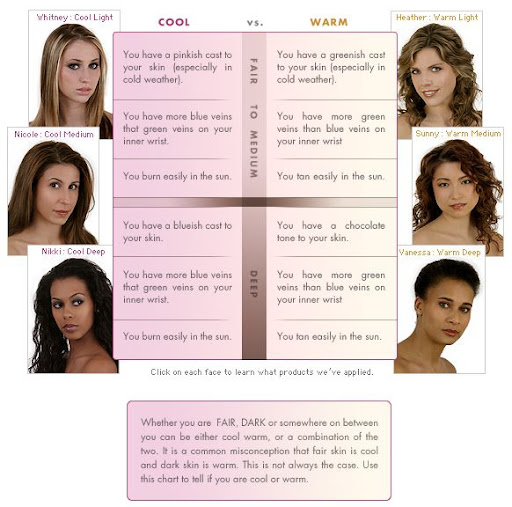
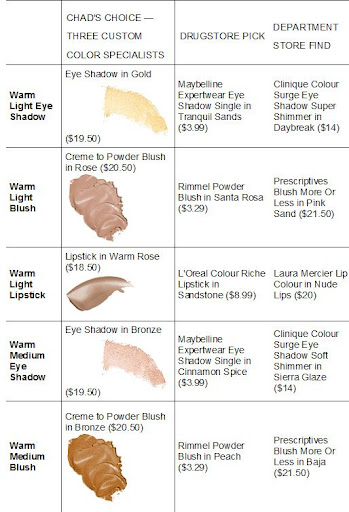
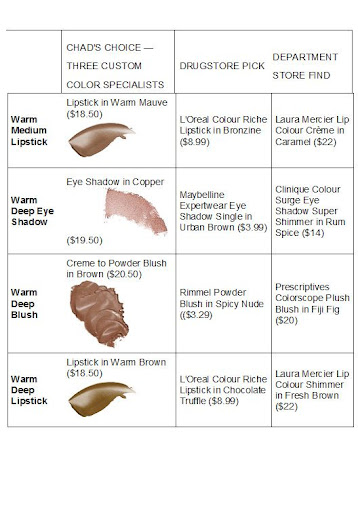
Many of you have probabley seen the words warm or cool skin tone attributed to a cosmetic product. Warm skin tones and cool skin tones can be broken down a bit more to include, olive skin tones, neutral skin tones and others, for now Im going to stick with warm and cool though.
There are many websites that give you different ways you can check to see what skin tone you are, the one chart that I have seen and that I thought was the simplest to comprehend is this one by 3Custom Colour.
In my researching it has proved difficult to narrow down what skin tone is exactly. In my opinion the best explanation by far is that of as mentioned above 3CC.
Many sites try to define whether you are cool or warm by your skin colour. I will post the chart from 3CC and you can see how they do it. I realize that I refer back to that company alot, but they have the most comprehensive information regarding skin tone that is not contrary that I have been able to find.
I am so frustrated right now its not even funny. For the past three days I have been searching for a 35mm empty pan or tin that would fit into a larger makeup palette. Japonesque has one that I really like, unfortunately the wells are 36mm wide so I need a pan that is 35mm wide, try as I may though, I can not find one of that size, if I find something close it has a lip or a "rolled edge" which Im sure would prove to be a problem. I have even tried searching for "Petri Dishes" and while I found some that were the right size the price was not right, at all.
So here I am still frustrated and wandering why companies make empty palettes of that size but don't sell the empty pans, whats up with that? Furthermore where-o-where are they getting them from? I have searched up and down.
If anybody knows where you can purchase empty pans that are 35mm deep with a "sharp" edge and that don't cost an arm and a leg please-o-please let me know.
Skin care information for those with combination skin. As every makeup lover and wearer knows or should know, makeup starts with good clean perferrabley clear skin, so here are Paula's suggestions for the care of combination skin. It is a little long so please bare with me. :)
Combination skin is a common skin type with the frustration of having to deal with both dry and oily skin. Because the nose, chin, center of the forehead, and the cheeks all have more oil glands than any other part of the face, it is not surprising that those areas tend to be oilier and may break out more frequently than other areas. At the same time, the areas that lack oil glands can become dry and flaky. Problems occur when you attempt to treat combination skin as one unified skin type. Many ingredients that are appropriate for the T-zone (the area along the center of the forehead and down the nose where most of the active oil glands on the face are located) won't help the drier parts of cheeks, eyes, or jaw areas and vice versa. More often than not, separate products are required to deal with the different skin types on your face because different skin types, even on the same face, must be treated differently to truly feel and look better. Once you accept this fact and adjust your routine, combination skin can be brought into balance, at least to the extent that using the right products allows! In fact, "balance" is a key word to keep in mind when dealing with combination skin. The goal is to provide your oily and drier areas with appropriate products that address the needs specific to these skin types.
The fundamental rule for all skin types of treating skin gently apply here, too, perhaps even more so. If anything, using overly-abrasive or irritating skin-care products on oilier areas will only worsen combination skin's dual nature by making dry areas drier and creating a rough, reddened appearance over oily areas. Plus treating skin harshly does not correct or improve oiliness in any way. Because combination skin should be viewed and treated as separate skin types, I have divided the battle plans below into three step-by-step sections. The first section lists general guidelines for combination skin, the second pertains to treating oily areas, and the third offers a protocol for treating your normal-to-dry (and, in some cases, very dry) areas. Special notes are included for dealing with combination skin that also experiences blemishes or blackheads in either oily or normal-to-dry areas.
General Guidelines for Combination Skin
- Wash your face with a gentle, water-soluble cleanser that does not leave skin feeling tight or dry. Most combination skin types do well with gel-based or mildly foaming cleansers.
- Avoid bar soaps or bar cleansers of any kind, regardless of claims of gentleness or no residue. The ingredients that keep a bar cleanser or soap in its bar form can clog pores, and the cleansing ingredients are always far more drying than a gentle cleanser contains.
- If you opt to use a toner, the same toner can be used all over the face if it does not contain ingredients that make oily areas feel slick or greasy. Water- and glycerin-based toners are ideal, but be sure they also contain plenty of antioxidants, water-binding agents, and, if applicable, cell-communicating ingredients.
- Sunscreen must be used every day, year-round. Make sure it contains one of these UVA-protecting ingredients: titanium dioxide, zinc oxide, or avobenzone. A foundation and pressed powder with sunscreen is perfect for this skin type to avoid applying moisturizers with sunscreen all over the face.
- Exfoliate and renew skin with regular use of a beta hydroxy acid (BHA/salicylic acid) product. BHA not only exfoliates the surface of skin it also exfoliates inside the pore to improve its shape and function.
- Treat dry areas (including the eye area) with a moisturizer loaded with antioxidants, water-binding agents, and ingredients that mimic the structure and function of healthy skin. Regular use of these state-of-the-art ingredients can eliminate dry skin. Make sure the product you buy is packaged in an airtight, opaque container (absolutely no jars) to keep the antioxidants stable.
- If sun damage or wrinkles are cause for concern (and they probably are, it is the rare person who has adequately avoided and protected their skin from the sun), consider adding a tretinoin product (Retin-A, Renova, Avita, etc.) to your nightly routine. Tretinoin is a cell-communicating ingredient that can generate normalized cells. These prescription-only products are available in different bases so you may choose the texture (gel, cream, lotion) best for your skin.
- Apply a well-formulated (meaning irritant-free and pH-correct) BHA liquid or gel at least once per day. This will not only help prevent oil blockages in the pores, but will also minimize blackheads and control blemishes. Salicylic acid is oil-soluble, which allows it to exfoliate inside the pore lining to keep dead skin cells and sebum (oil) from causing problems. It is also acceptable to apply the BHA product over your normal to dry areas. However, you may need a more potent BHA product (one containing 2% salicylic acid, for oily areas. You may have to experiment to see if a product containing 1% salicylic acid is more suitable for normal to dry areas.
- Use an oil-absorbing facial mask as needed but only apply it over oily areas. Apply after cleansing, leave on for 10-15 minutes, and then rinse thoroughly.
- If you are prone to blemishes, apply a topical antibacterial product containing benzoyl peroxide. Research in the medical journal Lancet (December 2004, pages 2188–2195) found benzoyl peroxide to be the most effective treatment, in comparison to oral antibiotics (such as tetracycline), topical antibiotics (such as erythromycin), or combination treatments. Oral tetracycline suffered in the comparison because of the common problem of eventual bacterial resistance to antibiotics. Begin with a 2.5% strength and increase the percentage if blemishes are unresponsive. If you are allergic to or your skin cannot tolerate benzoyl peroxide, then you may want to consider topical prescription options such as clindamycin, erythromycin, tetracycline, or Differin (adapalene) Gel. Tea tree oil is also an option, but has limited research supporting its effectiveness, and it is difficult to find the recommended concentration.
- For sunscreen, the easiest route is to use a matte finish foundation and pressed power with broad-spectrum sun protection, rated at least SPF 15. You would only apply moisturizer or serum to dry areas prior to applying foundation. If you do not use foundation, choose a regular sunscreen with a matte finish.
- Supply oily areas with the antioxidants and cell-communicating ingredients it needs in either serum or toner form. In this manner, your skin will benefit without making oily areas worse or causing clogged pores. Make sure the serum is alcohol-free and either silicone- or water-based.
- If oily areas become too shiny during the day, use oil-blotting papers to absorb the excess shine then touch up with a lightweight, sheer pressed powder, applied with a brush.
- For extremely oily areas, apply a thin layer of plain Milk of Magnesia prior to foundation with sunscreen. The magnesium hydroxide is more absorbent than clays or talc, and also has antibacterial properties for skin. A similar option that is more cosmetically elegant is smashbox’s Anti-Shine in Smashing Neutral (colorless).
- If sun- or hormone-induced discolorations are present, choose a gel-based skin lightening product containing 2% hydroquinone and apply at least once per day to affected areas.
- As described above for treating oily areas, a BHA product is an option, even if blemishes and/or blackheads are not present. The difference is that for drier areas, you may prefer a BHA in a lotion or cream base. Begin with a 1% concentration and step up if needed (this may be necessary during summer months). If blemishes are present over dry areas, a BHA product is a must. Begin with 1% salicylic acid and step up to 2% concentration if needed.
- If blemishes and blackheads are not a concern, a well-formulated AHA product may be used all over the face or just over drier areas. For all-over use, choose an AHA gel containing at least 8% glycolic acid. For use over dry areas, you may prefer an AHA product in a lotion or cream base. Both AHA and BHA products are excellent for improving the appearance and feel of sun-damaged skin and encouraging skin cell turnover.
- A soothing, moisture-infusing toner may be used after cleansing to reinforce skin's lipid barrier and boost hydration prior to applying a serum or moisturizer. Apply the next product when skin is still damp from the toner.
- Since applying two separate sunscreens can be tricky, your best bet is to get daily facial sun protection from a foundation with sunscreen rated SPF 15 or higher. It should have a matte finish for your oily areas. Because a matte finish can exaggerate dry areas, it is essential to apply a rich serum or moisturizer prior to foundation. For obvious reasons, keep such items away from oily areas.
- Choose a moisturizer loaded with antioxidants, water-binding agents, emollients, and ingredients that mimic the structure and function of healthy skin. Make sure it is packaged in an opaque container (no jars) to keep the antioxidants stable.
- A serum-type product may be all your dry areas need to look and feel better. More severe dryness will benefit from an antioxidant-rich serum paired with an emollient moisturizer.
- Use a moisturizing facial mask as needed. Make sure it contains several emollients (such as non-volatile plant or nut oils) and leave on dry areas as long as needed, including overnight.
- If your eye area is the driest part of your face, you may need a richer cream or serum than what is needed for other normal to dry areas of your face. Apply sparingly and allow a few moments to absorb before applying makeup. At night, you may want to apply your regular moisturizer to the eye area and follow with a thin layer of olive, evening primrose, or borage oil (all are extremely emollient as well as potent antioxidants).
- If blemishes are present over dry areas, apply a 2.5% benzoyl peroxide product in a lotion base. If blemishes do not respond, switch to a product containing 5% benzoyl peroxide. If you are allergic to (or your skin cannot tolerate) benzoyl peroxide, consider topical prescription options such as clindamycin, erythromycin, tetracycline, or Differin (adapalene) Cream.
- If sun- or hormone-induced discolorations are present, choose a lotion- or cream-based skin lightening product containing 2% hydroquinone and apply at least once per day to affected areas.
For research and studies supporting these recommendations please refer to the Ingredient Dictionary and look up the specific ingredient (such as alpha hydroxy acid, salicylic acid, tretinoin, benzoyl peroxide, antioxidant, cell-communicating ingredients, etc.).
Hey
Just wanted to let everybody know that I am still alive. I have just been focusing on other things at the moment. but I will be back.
Peace.love and cupcakes :)
Two words. I want!!!! :)
They are said to be the best or one of the best brands for makeup brushes in the industry.


PROFESSIONAL BRUSH SETThe most comprehensive, professional brush set. 11 artist’s essential brushes for the professional application of face, cheek, brow, eye and lip color in a premium, black leather brush roll. Ideal for makeup aficionados and professional makeup artists.
The Professional Brush Set includes:
FACE -
Natural Brush 20B – A wide, dense-bristle brush applies loose and pressed powder to large area in one quick stroke.
CHEEKS-
Natural Brush 17– A rounded design for very soft application of color to cheeks. Ideal for layering of color.
Natural Brush 7.5EXG - Fan shaped for delicate application of intense color, or soft blending and dusting of excess loose powders with a soft touch.
EYES -
Synthetic Brush 10 – A multi-purpose brush for powder, cream and liquid eye shadow application. Ideal for application of concealer in targeted areas.
Natural Brush 10 - For standard eye shadow application with maximum control between lash line and crease area.
Natural Brush 10DF – A sharply angled brush with firm and dense bristles for contouring with intense color.
Natural Brush 5F – Short-haired and flat-shaped for correction or blending of pencil eye liner color with ultra precision.
Natural Brush 2R - Shaped to apply precise color along the lash line with a slightly smoky finish.
BROWS -
Natural Brush 6OB – Firm-textured, short haired brush with a slanted tip for eyebrow defining. When dampened, this brush can be used to apply shu uemura Pressed Eye Shadow as an eye liner.
Synthetic Flat Eyebrow Brush - Flat shaped with soft bristles to comb fine eyebrow hairs and blend eyebrow color.
LIPS -Natural Brush 6F - Flat shaped for precise control in lining, shaping and shading lips.
Leather Brush Case 14 – Black leather brush case with a PVC interior that holds up to 14 makeup brushes of various styles. Also includes an anti-bacterial lining for the optimum maintenance of brushes. Lies flat for easy, convenient identification of brushes. Rolls into a pouch for portability.
PRICE $469.00

